


On July 10, 2023 FEEL was invited to share our insights on thriving as a gender and sexuality education academic and researcher community at the British Educational Research Associations online event ‘Pride, Prejudice and Sensitivity: being and becoming a gender and sexuality education researcher and academic’. The event was hosted by Professor EJ Renold, Cardiff University, BERA Sexualities and Gender SIG convener. We were also joined on the program by Dr. Leanne Coll, Dublin City University, promoting their collaborative book Uplifting Gender and Sexuality Education Research.


Idil Cambazoglu and Betsy Milne, on behalf of FEEL, presented our fight for Trans-inclusive Feminisms. It was also a pleasure to have a conversation with postgraduate and early career researchers, discussing their thoughts and expectations for the gender and sexuality education academic community. Here we are sharing our key takeaways from the workshop.
FEEL’s Feminism
‘
How can we continue to imagine the political potentials of transfeminisms while also attending to a current political moment in which globally critical scholarship and activism on gender, sexuality, race and migration is under attack (Tudor,2023)?
hjgkjjkbnmbh
’
In response to the trans-exclusionary movement (whose key tenet is the belief that biology determines gender) in social media, politics and academia, FEEL’s feminism emphasizes trans-inclusivity. Our evidence-based and intersectional approach is central to our activism and struggles against any forms of prejudice and hate.
FEEL believes…
- trans-inclusive and trans-formative potentials in the current political moment emerge when we name such trans-phobic and transmisogynistic practices and call out how they manifest in academic and educational spaces.
- feminism as an empathetic project that embraces gender expression, expansion, and fluidity. Trans-ness in all its guises is fundamental to our feminism.
- diverse backgrounds allow us to bring a de-colonial perspective to our work on gender and sexuality.
- fostering new, innovative, arts-based, and participatory approaches to feminist research and activism challenges traditional binary understandings of gender and center creative expression and diverse narratives.
- the power of collective action and reflexive collaboration, recognizing that meaningful, effective, and long-lasting change requires the input of multiple voices.

To those in power…
- we demand an end to the systemic institutional silencing and erasure of transgender voices.
- we urge educational institutions to take responsibility and work towards creating safer policies that practically promote inclusion, equality and job security.
- we demand this so that we can imagine safer universities so that we can be safe and FEEL safe.
Our Ongoing Struggle
In the Q&A session, an attendee raised a crucial question about ‘how we deal with pushback within the uni/wider academic landscape for being an explicitly and vocally trans-inclusive feminist group’. Indeed, we continue to encounter such backlash and it is very tricky. We noticed that on the campus there are numerous small but separated and isolated groups of trans communities. Although it could be very difficult and it is an ongoing struggle, one of the ideas that we came up together is that we need to unite all these separated and isolated groups, fostering a joined-up approach to equity and inclusion for all.
‘We are still navigating our way to it, and it does challenge institutionally for our professors, for ourselves, for our research. It can be dangerous, unfortunately, but we are optimistic.’ Idil Cambazoglu answered in the Q&A.
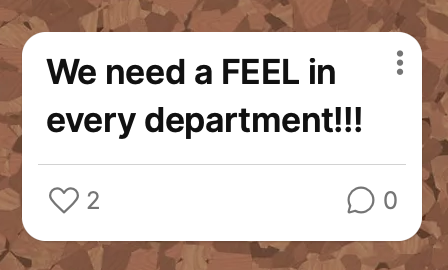
We need more ‘FEELs’
When exploring the question of “what support(s) do you need to thrive in being/becoming a gender and sexuality education researcher and academic?”, we recognize the desire for collaborative connections/networks/clubs or groups among researchers. As Professor Jessica Ringrose stated, ‘We have to create solidarities.’ We envision a future with a greater presence of trans-inclusive and trans-formative groups specifically for gender and sexuality education researchers and academics. Such initiatives would ensure that FEEL, too, is not isolated in its endeavours.

References and Recommended Readings
Olufemi, L (2020). Feminism, Interrupted: Disrupting Power. Pluto Press. https://doi.org/10.2307/i.ctvxrpzvs
Tudor, A. (2023). The anti-feminist of anti-trans feminism. European Journal of Women’s Studies, 30(2), 290-302. https://doi.org/10.1177/13505068231164217
Zanghellini, A. (2020) Philosophical problems with the gender critical feminist argument against trans inclusion. Sage Open, 10 (2). ISSN 2158-2440
Blog Author: Sitian Chen
 Feminist Educational Engagement Lab