

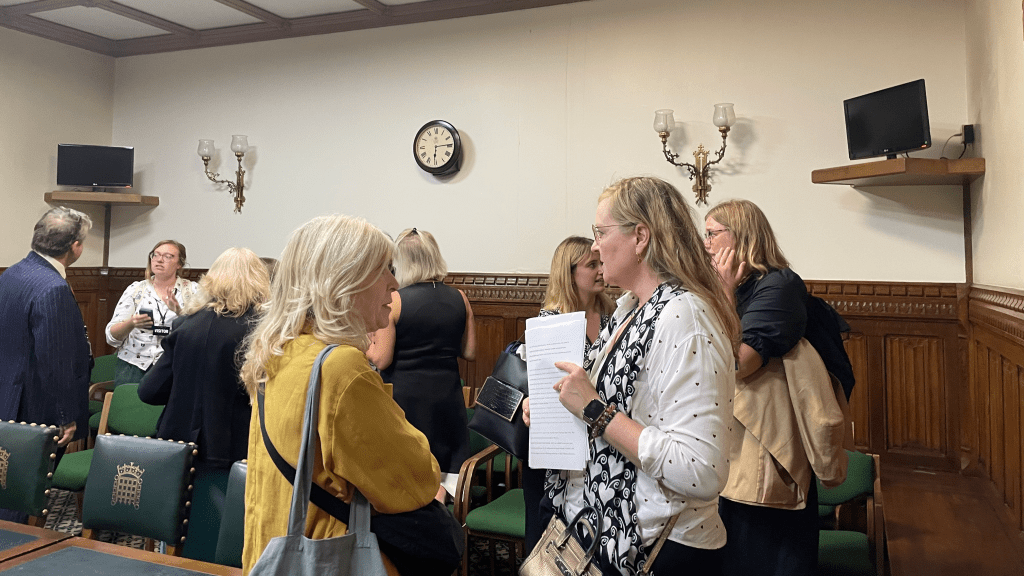
On September 12, 2023, Professor Jessica Ringrose, the co-director of the UCL Centre for Sociology of Education and Equity, along with two other speakers (Gemma Kelly from CEASE and Jessica Edwards from Barnardo’s) was invited to present on the topics ‘Sexual Harassment of Girls in Schools’ to The All-Party Parliamentary Group on a Fit and Healthy Childhood. During her presentation, she highlighted the normalisation of endemic sexual violence, harassment, and abuse amongst young people in the UK, the continued need for comprehensive, whole-school relationship and sex education for students and educators, and a sexual violence prevention intervention she helped design. This one-hour discussion sparked a high degree of concern among Members of Parliament (MPs), prompting the suggestion that copies of each speaker’s presentation be distributed to more MPs within Parliament. This would help raise awareness about the pressing issue of sexual harassment in schools. For those interested, we provide a retrospective summary of Professor Jessica Ringrose’s presentation.
The normalisation of sexual violence, harassment and abuse in schools
Over recent years, there has been an increase in societal awareness and concern about the problem of sexual violence, abuse and harassment experienced by young people in England.
Research reports and findings include:
- The 2016 Women and Equalities Committee Report uncovered inconsistencies in how schools handle sexual harassment and violence, neglect of national and international equality laws, and a lack of teacher guidance.
- Everyone’s Invited, was created in 2020 to document rape culture in schools, compiled over 50,000 testimonials of sexual violence in schools, listing over 3,000 schools, colleges and universities.
- Ofsted Review (2021) found that the harmful sexual behaviours were so frequent that some children and young people considered them ‘normal’.90% of girls interviewed reported frequent sexist name-calling and unwanted explicit content.
- Yet again, the 2023: Women and Equalities Committee Report ‘Attitudes towards women and girls in educational settings’ found sexual violence as a pressing issue and suggested that the online safety bill could address pornography regulation. But beyond internet regulations, we need educational reform. The latest government report also called for better relationship and sex education noting schools’ need to “develop a specific strategy for engaging with boys and young men in primary and secondary schools on the topics of sexual harassment and gender-based violence.”
The need for comprehensive, whole school Relationship and Sex Education that addresses youth digital gender and sexual cultures
These reports contain welcome recommendations but neither the problem nor the solution lies with boys alone. A global evidence base shows that gender inequity is tied to gendered stereotypes and fixed ideas about naturalised, highly differentiated forms of masculinity and femininity. Such gender norms are often part of the hidden curriculum at school and reinforced through a range of explicit policies and curricula, which can reproduce misogyny and LGBTQ discrimination. The solution requires attention to sexual and gender diversity (SAGD). In addition, there has been limited research that has explored diverse youth experiences of tech facilitated gender-based violence or image based sexual abuse and harassment. Jessica Ringrose and colleague’s research has sought to explore both of these areas of concern and to look at the convergence of young people’s online and offline lives through their peer relationships and networks, which are often school based and the gendered and sexualised.
- According Ringrose, Regehr and Milne’s 2021 report Understanding and Combatting youth experiences of image based sexual harassment & abuse, 75% of girls in focus groups had received an unwanted image of male genitals. Only 5% of young people told their parents/carers about their experiences of image-based sexual harassment and abuse, and a mere 2% reported it to their school.
- Ringrose, Horeck, Milne and Mende’s 2022 research on youth experiences of tech facilitated sexual violence during and after covid 19 found 96% of young people’s screen time increased during covid and 48% experienced some form of tech facilitated sexual violence. Gender minorities and girls are more than twice as likely to experience IBSHA.

What is needed, therefore, is a multipronged, whole-school approach to understanding and addressing gender and sexual norms, with a focus on preventing sexual violence with up-to-date information on young people’s legal and human rights covering issues of online safety and support.
Our effort: A sexual violence prevention intervention to address youth’s postdigital experiences of sexual violence
Funded by a UK Research and Innovation grant, UCL and academic partners have produced a series of resources with the Association of School and College Leaders including two workshops on sexual and gender-based violence and bystander interventions and an online sexual harassment school policy.
In this educational intervention, accurate definitions of gender-based sexual violence, including the latest offences such as cyberflashing and upskirting were defined for students. It also covered a wide range of sexual violence in a wheel configuration to show they are on a continuum. The two workshops offer space to explore what constitutes sexual abuse, harassment and offences, but also what are legal but still harmful behaviours. The aim is for young people to know their rights and where to go for support.
In 2022, these workshops were piloted with over 1, 200 young people across England, Ireland and Canada, receiving overwhelmingly positive responses. We found:
- 55% of young people had never learned about the issue of sexual violence in school prior to the workshops.
- 89% of respondents agreed or strongly agreed that Workshop 1 improved their knowledge of sexual violence and the different forms it takes.
- 98% agreed Workshop 2 improved their understandings of how to be an active bystander in situations of sexual violence.
- 95% of teachers agreed or strongly agreed that the training workshop had improved their knowledge of what sexual violence is and the different forms it takes.
Developing, piloting and evaluating these resources evidence that with accurate information teachers and young people can start to better understand and can therefore schools can be better equipped to prevent sexual violence in online and offline contexts.

Conclusion: Need for a multipronged intersectional approach
During the discussion, some participants raised concerns about whether the proposed measures might inadvertently lead to the criminalization of young men or place undue stress on schools and teachers. We also noticed the conversation predominantly focused on the topics of online sexual harassment and pornography and government regulation rather than investment in better education. In response to these important concerns, we reaffirmed the necessity of adopting a multi-pronged, intersectional, whole-school approach to understanding and addressing gender and sexual norms. This approach acknowledges that boys and young men, schools, teachers, as well as internet and pornography regulations all play crucial roles in preventing sexual violence and harassment. However, it is important to emphasize that neither the problem nor the solution can be attributed solely to any one of them and the gamut of gender and sexual equity, diversity and rights must be addressed.
We need the first basic step to let young people understand what is sexual violence and how it impacts diverse young people in complex ways. We have the educational policy, curriculum and training tools to reduce sexual violence and harassment in and around schools and now we call for the political will to implement these educational supports to create a healthy, safe and equitable society for all.
Blog author: Sitian Chen & Jessica Ringrose
 Feminist Educational Engagement Lab