

This week UCL FEELers Jessica Ringrose and Chiara Fehr joined the extended advisory panel of the DRIFT project: Drifting and Reaffirmed Boundaries – Young people, gender and body in a digital age at Aarhus University in Copenhagen for two days of presentations, workshops, and discussions with both junior and senior researchers alike. Unlike a traditional advisory board, Dorte-Marie Søndergaard and her team chose to go the unconventional route and gathered a group of students and established scholars researching youth cultures in the digital age to share their cross-generational research, methods, and opinions.


DRIFT – The project
Digital spaces are drastically impacting the lived experiences and identity formation of young people. While social media can provide a space of exploration and play, the increasing complexity of emerging technologies raises both public and academic concerns around the wellbeing of young people online.
The hypothesis of the DRIFT project is that “socio-technical changes destabilize young people’s sense of gendered and embodied boundaries”. They further hypothesize that “risks and attractive possibilities entangle in complex, undetermined and often confusing ways, which force young people into intricate social negotiations.”
The project therefore seeks to research young people’s use of digital spaces, tracking their negotiation of boundaries around gender expression in their identity formation, and seeking to understand how this impacts their feelings of belonging.
The Questions
Over the two days our group engaged in discussion about a variety of tops grounded by the following questions:
- How do young people perceive, practice and transgress ideals and norms related to body and gender through their digital interactions?
- Which strategies are used, and which boundaries are contested by whom?
- How do these processes affect young people’s social relating, being and becoming?”
The thoughts shared
With 10 of us around an oval table while the Danish rain poured down outside, the topics covered were as follows:
Penille Rasmussen + Dorte Marie Søndergaard – Material discursive transgression and reconfigurations of the body in a digital age: Young people negotiating skin, authenticity, perfectionism, and subjectivity.
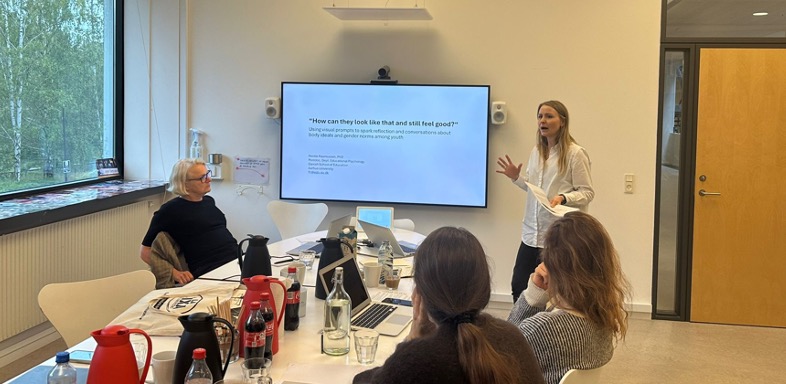
Starting with Haraway’s (1991) provocative question, “Why should our bodies end at the skin?” (p. 195), Penilled’s ‘work-in-progress’ paper draws on material from the DRIFT project and explores how young people negotiate the boundaries and meanings of the body in their analogue-digital everyday lives. Her presentation addressed the material-discursive transgressions and reconfiguring the body in ways that blur the lines between young people’s internal and external worlds, thereby challenging the notions of authenticity and perfection. Informed by scholars challenging notions of the body as ‘mere biological container’ Penille’s analysis conceptualizes the body not as a biological vessel but as a material-discursive phenomenon that actively constitutes the subject.
In addition to her presentation Penille shared her research methodology through a participatory workshop. Choosing from a number of pictures, we selected those that attracted us and those we found repulsive, an exercise showing diverse opinions and navigations of normative categories of embodiment.
Deniz Celikoglu + Debbie Ging– Podcasting Misogyny: A Narrative Discourse Analysis of Three ‘Manfluencer’ Podcasts on YouTube

Focusing on the storytelling nature of YouTube podcasts, Deniz presented her study which investigates how ‘entrepreneurial’ identities are crafted and communicated through the manfluencer podcast format, with a particular interest in how the personal stories of manfluencer guests operate at an affective, rhetorical and ideological level. In her presentation she discussed how a constellation of neoliberal economics and platform affordances has fostered a new influencer economy, which has produced ‘heavily gendered iterations of the ‘rags-to-riches’ narrative.’ These discourses, she argued, have become incredibly popular with young men who experience financial and emotional insecurities and who respond to the ‘entrepreneurial,’ self enhancement cultures of the manosphere.
Chiara Fehr – Algorithmic Girlhood: tracking TikTok’s influence over teenage girls’ conceptualisation of female sexuality

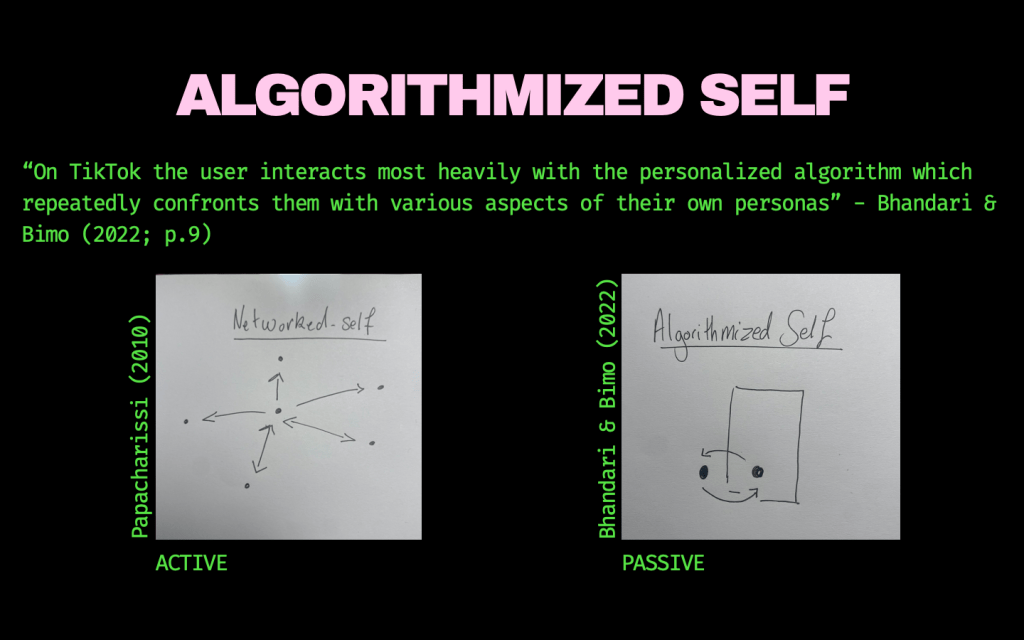
As social media platforms become digital extensions of our social reality, they increasingly constitute spaces where teenage girls express and explore their sexual selves. In her talk, Chiara presented algorithmic constitutions of self as theorized by Bhandari and Bimo (2022) and discussed how TikTok’s affordances created an environment which enabled young women to explore their sexuality in an algorithmically digitally mediated context. This included examples such as ‘algo speak’ arising from community guidelines banning certain words, algorithmic community creation, and the app’s filter function re-enforcing normative beauty standards. To facilitate the exploration of the chaotic algorithmic environment, she presented her original ‘TikTok Diary’ methodology, which takes inspiration from photo voice research and combines screen recording with reflective tasks with young people.
Jessica Ringrose – Researching & Challenging Postdigital Sexual Violence on Screens & in Schools

In her presentation, Jessica shared some of the projects she has been involved in throughout the past years with collaborating partners such as the School of Sexuality Education, the Association of Schools and College Leaders (ASCL), UK Safer Internet, and SouthWest Grid for Learning. She explained topline findings from recent reports including: ‘Understanding and Combatting Youth Experiences of Image-Based Sexual Harassment and Abuse,’ Equipping Young People to Navigate Post-digital Sexual Violence and Young People’s experiences Technology-Facilitated Gender-Based Violence During COVID-19. She discussed how she has recently been working with the concept of postdigital intimacies and her new article:‘ Young People’s Experiences of Algorithmic, Tech-Facilitated Body Shaming and Image-Based Sexual Abuse during and after the COVID-19 Pandemic in England.’
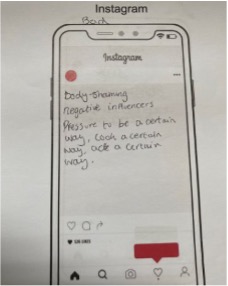
Jessica shared some of the creative practices she used in these research projects, including using arts based methodologies to capture young people’s feelings about social media including methodologies developed to help young people explain what they like and dislike about Tiktok, Snapchat and Instagram through platform specific templates as above.


Kirstine K. Høgsbro – Taking the insights about gender and sexuality into art and theatrical expressions.
Reading an excerpt of one of her plays, Kristine posed a dystopian narrative which tackled the mundane yet vanquishing exhaustions of everyday life manifested in characters contemplating company encouraged kidney donation, self-referral to solitary confinement, and mere existence itself. Humorous with the irony of relatability, Kirstine’s play sparked discussions around the use of theatrical methods to explore, and offer up resolutions to the complexities of young people navigating digital spaces. It was agreed that when writing about a group of people, it is of utmost importance to consult them and their experiences to correctly and impactfully capture their struggles.
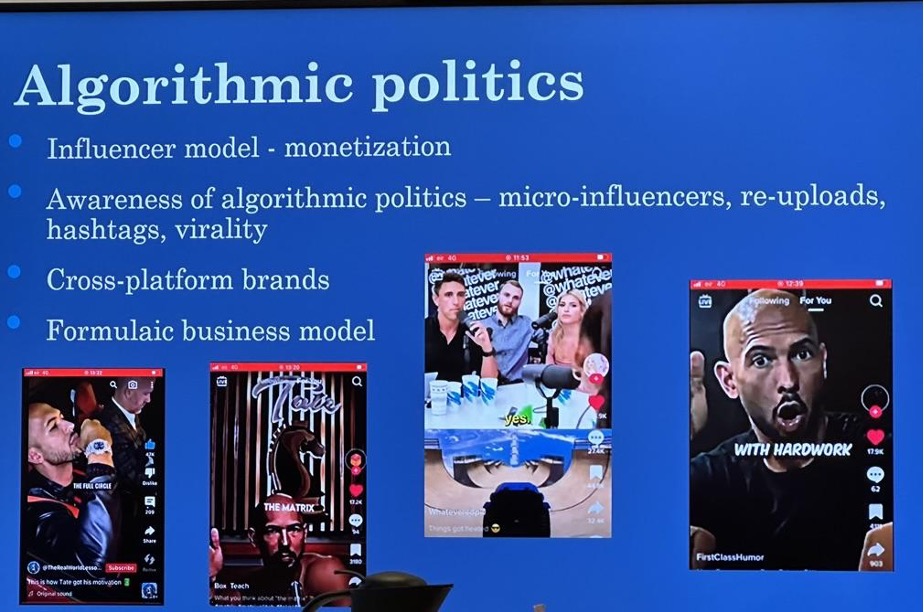
Catherine Baker + Debbie Ging – Algorithmics politics, neo-masculinist rhetoric & mediated bodies: Exploring the new ‘Manfluencer Industrial Complex’.

The algorithmic amplification of male supremacist rhetoric via short-form video platforms such as TikTok and YouTube Shorts is an area of growing concern as ideological entrepreneurs such as Andrew Tate and Myron Gaines have accrued significant followings.
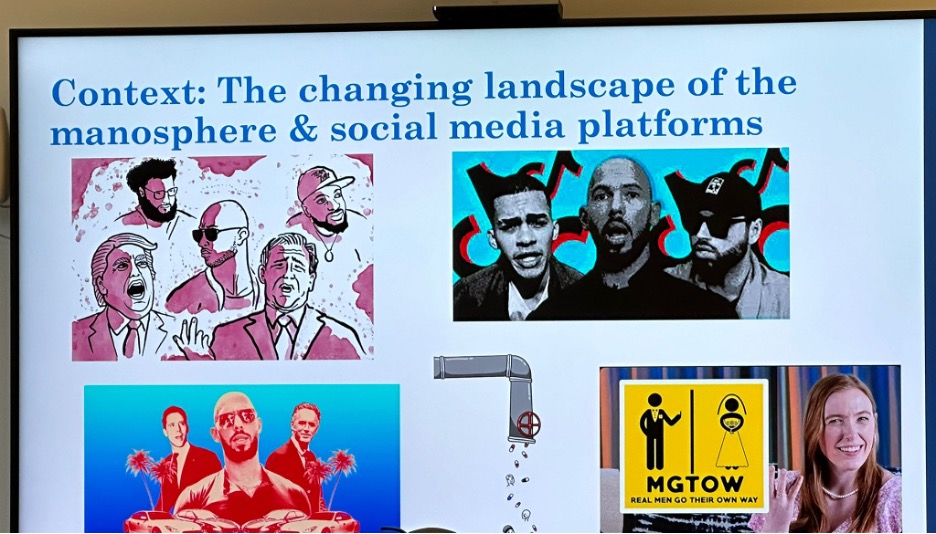
Propagating self-help personas they monetise male insecurity while mainstreaming anti-feminist and reactionary right-wing talking points. In her presentation Catherine shared research findings of a paper in progress based on an ongoing qualitative analysis of video data from so-called ‘manfluencers’. Through ‘sock puppet’ accounts standing in for young men on TikTok and Youtube, she discussed the role of platforms recommender algorithms in the radicalization of young boys and men.
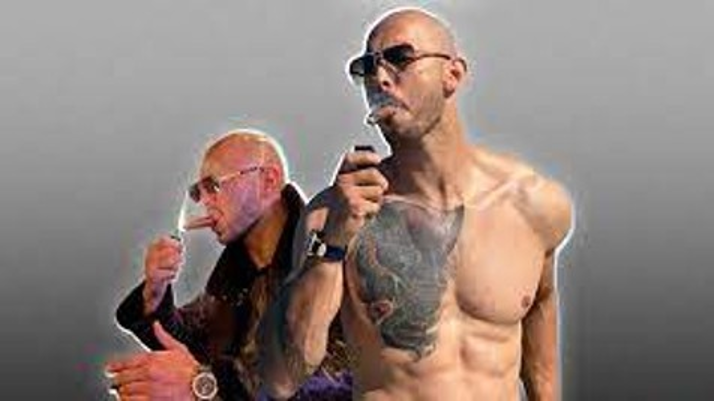

The advisory group audience members remarked upon the constant phallic signifier of the cigar as a symbol of dominant heter-masculinity prowess or ‘wealth porn’ in the videos!
Frederikke Skaaning Knage: What is the new in the traditional – what is the traditional in the new? Gender negotiations among young people 2024
Presenting her work on gender negotiation amongst young people, Frederikke shared a number of interactions between the young people she had interviewed as part of the DRIFT project. The conversations between young people negotiated heterosexual attraction and beliefs of ‘appropriate’ and ‘inappropriate’ forms of gender expressions, often discussing boundaries around align themselves with queer people surrounding them. This presentation particularly sparked discussions on ‘new-ness’ of gender diversity and queerness, and the responsibilities we hold as researchers opposite our participants.
Giorgia Scuderi: Workshop – Storytelling Session: fairy tales as research methodology focusing youth analogue-digital becoming

The seminar’s final workshop Giorgia delivered a truly remarkable take on creative methods, sharing with us her ‘Fairy Tale’ approach. Utilizing the Japanese theater technique of Kamishibai, she explored how young people responded to a narrative which stood in as metaphorical to bullying, gender identity negotiation, and self discovery as a young person. Prompted by beautiful drawings capturing key moments in the story we discussed topics from champion narratives, unpredictable chaos, and toxic online communities.
 Feminist Educational Engagement Lab