

Professor Sonia Livingstone introduced the Digital Futures for Children (DFC), a joint research centre between LSE and 5Rights Foundation which advances understanding of the challenges and opportunities presented by digital technologies for children’s rights and needs. In her presentation, she underscored the interconnected nature of children’s rights, highlighting how protection from gender-based violence should be considered alongside civil rights, privacy, and the right to be heard. Children and young people are facing multi-dimensional digital challenges globally.
The research outcomes of the Digital Futures for Children involve forming a general comment on how the Convention on the Rights of the Child applies to the digital environment.
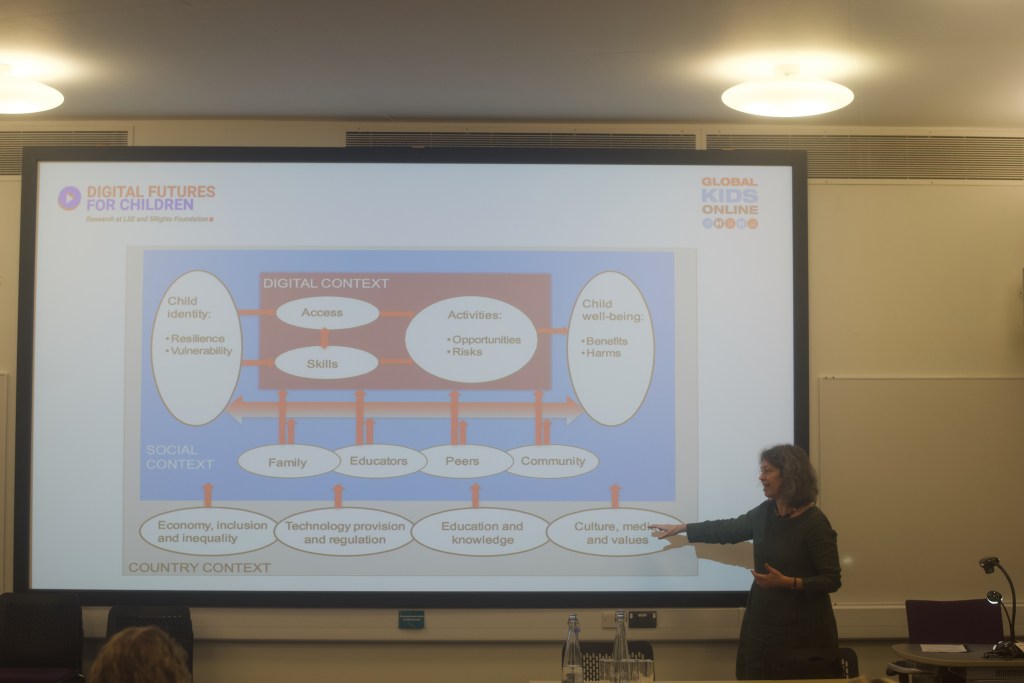
They are also developing a model aiming at understanding the impact of various elements on young people’s engagement with the digital world. The model considers diverse factors influencing this interaction, acknowledging the challenges researchers face in navigating multiple layers of influences. This analysis can also extend to the country level, acknowledging the vast variations in childhood conditions globally, encompassing technology access, regulatory frameworks, and societal attitudes. The goal is to understand the factors influencing child resilience and vulnerability, their impact on well-being, and the dynamics of their lives in the digital context, considering both online and offline aspects.
Another framework, the ‘4Cs framework’, which is designed to analyze the relationships between platforms, technologies, and children was also introduced by Professor Livingstone. It highlights the impact of major platforms and various companies on children’s experiences.
Although most of the attendants focused on the UK setting, Professor Livingstone also presented data from the international level and pointed out the importance of insights from children worldwide, especially those in the global South to understand the intersectionality of children’s rights and their digital experiences across various countries.
The presentation was concluded by calling for a global recognition of restorative justice over immediate punishment, especially when young people are involved in actions contributing to or exacerbating violence against others. The Q&A discussion also touched on the impact of AI-generated content on young people, emphasizing the need for a mix of awareness, education, and regulation.
Blog author: Sitian Chen
 Feminist Educational Engagement Lab