

Blog author: Sitian Chen and Jessica Ringrose
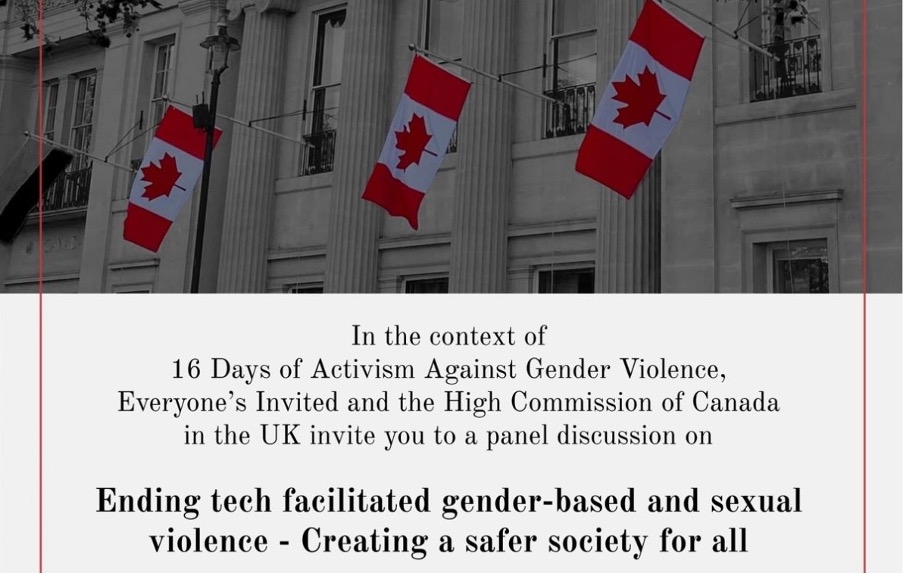
On 1 December 2025, as part of the global 16 Days of Activism Against Gender-Based Violence, the High Commission of Canada in the United Kingdom hosted a significant panel event at Canada House on 1 December 2025. The panel brought together leading voices in the field:
- Jessica Ringrose, Professor of the Sociology of Gender and Education, UCL
- Soma Sara, Founder and CEO, Everyone’s Invited
- Eve Kraicer, Policy Manager for Online Safety, Ofcom

One of the most striking aspects of the evening was that half the audience were teenagers. Students from Everyone’s Invited’s Student Advisory Board opened the event by describing how young people navigate today’s online world. Their clear and affirmative call for ending tech-facilitated gender-based violence set the tone for the discussions that followed. It was also exciting to see teachers in attendance, which transformed the event into a multi-generational dialogue on misogyny, harassment, and consent cultures within schools and online platforms.
The discussion focused on the challenges and hope of ending tech-facilitated gender-based and sexual violence, bringing together researchers, policy experts, educators, youth representatives, and advocates working at the intersection of digital safety and gender justice.
Why Tech-facilitated Gender-based Violence must be addressed
Across the conversations, an emerged consensus was that tech-facilitated gender-based violence is not a marginal issue but a widening issue. Students described how normalised rape culture feels within peer networks, both offline and online. The pressure shaped deeply by digital content and algorithms on girls to conform to appearance standards begins earlier each year. Social media environments continue to expose young people to harassment, image-based abuse, and misogynistic ideologies. Speakers emphasised that tech-facilitated violence is escalating faster than current protections, creating an uneven landscape in which young people are expected to self-manage risks that should never have been their own responsibility.
Despite the scale of the problem, the event highlighted significant progress. Regulatory bodies, like Ofcom, are working to strengthen accountability for harmful content. Youth-led movements, like Everyone’s invited, have transformed public conversations about rape culture in schools. Researchers and educators, like Prof Jessica Ringrose, are developing new frameworks for understanding online harm, digital citizenship, and youth voices.
Yet, as several speakers noted, the challenges are evolving quickly. Deepfakes, AI-generated sexual content, social media ban and increasingly complex online ecosystems require more flexible and intersectional approaches. Offline and online harms are now inseparable, and our strategies must reflect this entanglement.

Why young people’s voices should lead the way
The most powerful message came from this event is that young people are not only affected by these issues, but they are also experts in their own digital lives. Their voices illuminate perspectives that policy and research alone cannot capture. Efforts on tackling this issue requires co-creation rather than top-down intervention. As one student speaker reflected, tackling misogyny and rape culture requires many more conversations like this event. It shows how transformative those conversations can be when young people are invited and centred.
The event at Canada House underscored that ending tech-facilitated gender-based violence requires sustained collaboration across education, policy, technology, and community sectors, but it also offered hope. The passion, intelligence, and courage shown by the young participants point to a future where digital spaces can be safer and fairer. If we are to build that future, we must continue to listen to young people, learn from them, and work alongside them.
Moving Forward
Following this event, Professor Ringrose and Everyone’s Invited delivered a session on 10 December 2026, Understanding and Preventing Tech-Facilitated Sexual Violence for young people, in collaboration with Everyone’s Invited, to the Crown Prosecution Service. Professor Jessica Ringrose and Alex Somers, Head of Education at Everyone’s Invited, spoke to over 100 lawyers and legal staff, discussing the rapid growth and normalisation of tech-facilitated sexual violence in young people’s lives.

The session drew upon research and survivor experience to highlight the realities of young people’s experiences of tech-facilitated violence and explored the cultural contexts in which these norms emerge. It also highlighted emerging crimes such as cyberflashing and deepfakes, as well as the lack of recognition and response to support young people, explaining that there is a significant gap in preventative education to address these issues.
The session then explored why young people often do not report abuse, including a lack of trust that adults will support them. Failures to support young people, or even to explain the laws around digital sexual crimes, leave many vulnerable to harm both now and in the future. The session concluded with a call for action from young people:

We also offered practical ways forward, including tools to build survivor empathy and empower young people’s voices. You can download the slides and find out more here.
 Feminist Educational Engagement Lab